
Wilmington Metropolitan University
(WMU)
Level 4 Certificate in Halal Certification Training (Manager Level)
Total Credits: 120
Total Qualification Time (TQT): 1,800 Hours
Guided Learning Hours (GLH): 600 Hours
1. Introduction
1.1 Why Choose WMU Qualifications?
WMU’s qualifications are structured to bridge technical know-how with strategic leadership.
This Level 4 Halal Certification Program for Managers prepares professionals to lead halal
operations across the entire value chain — from sourcing to certification and global export. It
builds on Level 2 and Level 3 foundations with a strategic, policy-driven, and risk-oriented
perspective.
2. Programme Purpose
2.1 Reasons for the Qualification
With the halal industry expanding globally, there is an increasing need for competent halal
managers who can interpret and apply halal laws, engage with regulatory frameworks, lead
audits, and ensure halal integrity across supply chains. This program delivers strategic
knowledge for senior decision-makers.
2.2 Rationale
This training equips participants with expertise in halal management systems, regulatory
integration, risk control, and continuous improvement. It supports organizations in
maintaining halal assurance from factory floor to certification body and export destinations.
2.3 Aims
To build strategic competencies in halal certification and compliance leadership.
To develop risk-based thinking, auditing, and policy implementation capabilities.
To train professionals in engaging with global halal frameworks and certification
processes.
To enhance halal reputation management, sustainability, and governance within
organizations.
3. Learning Outcomes
By the end of this program, learners will be able to:
1. Design and implement organization-wide halal management systems.
2. Interpret and align operations with multiple global halal regulatory frameworks.
3. Oversee certification and audit processes with risk-based strategies.
4. Formulate halal compliance policies and ethical governance structures.
5. Lead halal-related crisis management, branding, and business continuity.
6. Guide cross-border halal strategies in supply chain and export logistics.
4. Entry Criteria
Open to:
Supervisors (Level 3 graduates) or equivalent work experience (minimum 3 years)
Mid-level professionals in QA/QC, food manufacturing, logistics, or certification
Prior learning (RPL) or a diploma-level qualification will be considered
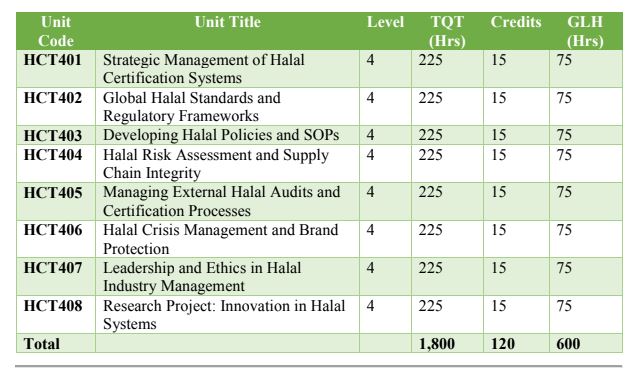
5. Qualification Structure
6. Assessment Strategy
Strategic project proposals
Risk audit simulations
SOP development assignments
Reflective essays on leadership scenarios
Research project report and presentation
Assessments focus on applied management, innovation, and real-world halal case analysis.
7. Progression Opportunities
Graduates of this Level 4 program can progress into:
✅ WMU Bachelor of Business Administration (BBA) – entry with advanced standing
✅ WMU Master of Business Administration (MBA) – through Recognition of Prior
Learning (RPL), especially for experienced managers
✅ Entry into roles such as Halal Compliance Manager, Export Strategy Lead, Certification
Consultant, or Halal QA Director
8. Equality and Inclusion
WMU supports lifelong learning and ethical leadership. This program welcomes learners
from all backgrounds who meet eligibility criteria and share a commitment to halal values,
global ethics, and quality assurance.
9. Unit Descriptors
🔹 HCT401: Strategic Management of Halal Certification Systems
Aim: Build capability to design, lead, and evaluate halal certification structures.
Topics:
Halal governance framework
Certification cycle (planning, audit, renewal)
Performance measurement in halal systems
Integrating halal with ISO/FSMS systems
🔹 HCT402: Global Halal Standards and Regulatory Frameworks
Aim: Equip learners with comparative insight into national/international halal standards.
Topics:
JAKIM (Malaysia), GSO (Gulf), MUI (Indonesia), ESMA (UAE)
Mutual recognition issues
Halal trade protocols
Import/export documentation
🔹 HCT403: Developing Halal Policies and SOPs
Aim: Guide learners to craft operational procedures ensuring halal assurance.
Topics:
SOP writing and review cycle
Documentation alignment with HCCPs
Policy enforcement and review
Control of changes and version control
🔹 HCT404: Halal Risk Assessment and Supply Chain Integrity
Aim: Apply risk-based thinking across the halal supply chain.
Topics:
Identifying critical halal risks (ingredient, logistics, processing)
Supplier approval systems
Supply chain traceability software
Fraud prevention strategies
🔹 HCT405: Managing External Halal Audits and Certification Processes
Aim: Train learners in external audit readiness and liaison.
Topics:
Pre-audit checklist and audit planning
Engaging auditors and certification bodies
Managing findings and non-conformities
Audit documentation and appeal processes
🔹 HCT406: Halal Crisis Management and Brand Protection
Aim: Build readiness for managing reputational and product integrity risks.
Topics:
Types of crises (recall, contamination, non-compliance)
Halal status revalidation
Communication protocols
Media handling and public statements
🔹 HCT407: Leadership and Ethics in Halal Industry Management
Aim: Promote ethical leadership and sustainable halal governance.
Topics:
Values-based leadership
Stakeholder engagement
Ethical dilemmas in halal sourcing
Governance frameworks (internal & external)
🔹 HCT408: Research Project: Innovation in Halal Systems
Aim: Encourage innovation through applied research.
Topics:
Research proposal development
Field investigation or industry-based project
Presentation and academic reporting
Innovation case studies in halal packaging, tech, or sustainability