
Wilmington Metropolitan University
(WMU)
Level 2 Certificate in Halal Certification Training (Worker Level)
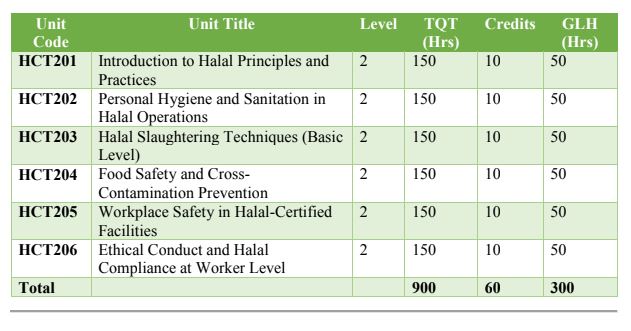
Total Credits: 60
Total Qualification Time (TQT): 900 Hours
Guided Learning Hours (GLH): 300 Hours
1. Introduction
1.1 Why Choose WMU Qualifications?
Wilmington Metropolitan University provides globally adaptable, industry-focused
qualifications to build practical and professional competencies. This Level 2 Halal
Certification program is designed to equip frontline workers in halal food production and
services with essential knowledge, skills, and attitudes aligned with halal compliance and
food safety standards.
2. Programme Purpose
2.1 Reasons for the Qualification
This program addresses the growing demand for trained halal workers in food production,
slaughterhouses, F&B services, and logistics sectors. It ensures that participants understand
and comply with Islamic principles, food safety, and hygiene protocols specific to halal
processes.
2.2 Rationale
The program develops practical halal-related skills and ethical awareness required to support
halal operations at ground level. This training enables organizations to enhance consumer
trust, comply with certification requirements, and minimize risks of non-compliance.
2.3 Aims
To develop awareness of halal concepts and lawful practices.
To instill hygiene, safety, and ethical conduct in halal-sensitive environments.
To train workers in basic halal slaughter, food handling, and contamination
prevention.
To foster responsibility and teamwork in halal-compliant operations.
3. Learning Outcomes
Learners completing the qualification will be able to:
1. Understand basic halal principles and Shariah-compliant practices.
2. Apply hygiene and sanitation practices in food and beverage settings.
3. Perform basic halal slaughter techniques.
4. Prevent cross-contamination and identify haram risk areas.
5. Follow safe operating procedures and comply with workplace safety standards.
6. Demonstrate professionalism, ethics, and accountability in halal-certified facilities.
4. Entry Criteria
This program is open to:
Entry-level workers in food services, slaughterhouses, food production, packaging, or
logistics.
Individuals with basic literacy and physical capability to perform operational tasks.
No formal qualifications required, but an interview may be conducted for suitability.
5. Qualification Structure
6. Assessment Strategy
Each unit is assessed via:
o Practical observation,
o Written tests or quizzes,
o Case scenarios and demonstrations,
o Oral questioning or supervisor reports.
Assignments are designed to simulate real workplace halal scenarios.
7. Progression Opportunities
Graduates may progress to:
Level 3 Certificate in Halal Supervision
Entry into halal production or processing jobs
Further TVET or food safety certification programs
8. Equality and Inclusion
WMU embraces inclusivity. This program is open to all eligible learners regardless of
religion, background, or demographic. Reasonable accommodations will be made for persons
with disabilities.
9. Unit Descriptors
🔹 HCT201: Introduction to Halal Principles and Practices
Aim: Introduce key concepts of halal, haram, and Shariah compliance.
Key Topics:
Meaning of Halal and Haram
Halal food categories
Principles of Shariah law related to food
Certification bodies and logos
🔹 HCT202: Personal Hygiene and Sanitation in Halal Operations
Aim: Ensure personal and workplace hygiene in line with halal standards.
Key Topics:
Handwashing and grooming
Clean uniforms and PPE
Workplace sanitation
Preventing contamination via personal habits
🔹 HCT203: Halal Slaughtering Techniques (Basic Level)
Aim: Train workers on basic principles of halal slaughtering.
Key Topics:
Slaughter conditions under Shariah law
Use of sharp tools and ethical treatment of animals
Invocation (Bismillah) and direction of qiblah
Handling meat post-slaughter
🔹 HCT204: Food Safety and Cross-Contamination Prevention
Aim: Identify haram risks and ensure segregation of halal food.
Key Topics:
Common haram ingredients
Storage and segregation
Cross-contact risks with alcohol/pork
Use of cleaning agents and sanitizers
🔹 HCT205: Workplace Safety in Halal-Certified Facilities
Aim: Promote safety and hazard awareness.
Key Topics:
Safety signage and PPE
Slaughterhouse safety
Fire safety and first aid basics
Manual handling and chemical safety
🔹 HCT206: Ethical Conduct and Halal Compliance at Worker Level
Aim: Inculcate integrity and accountability in daily tasks.
Key Topics:
Responsibility in reporting non-compliance
Ethics in food handling
Working under supervision
Respecting religious and cultural sensitivities